Marshmallow (Althaea officinalis)
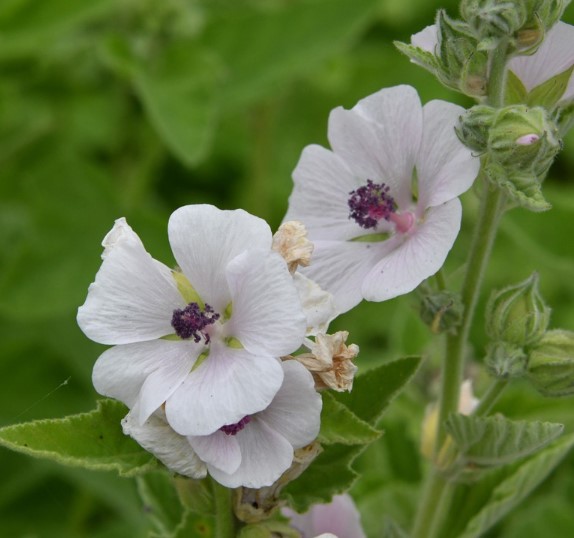
How to Identify the Marshmallow Plant
The marshmallow plant, (Althaea officinalis), is a perennial herbaceous species renowned for its historical use in confectionery and medicinal applications. Accurate identification of this plant involves observing several distinctive features:
Characteristics
- Height and Structure: Typically grows up to 1.2 meters (4 feet) tall, with a sturdy, erect stem that may be slightly hairy.
- Leaves: The leaves are ovate to lanceolate, measuring approximately 5–15 centimeters in length. They possess a soft, velvety texture due to fine hairs and have serrated margins.
- Flowers: The plant produces pale pink to white flowers, usually around 2 centimeters in diameter. Flowers are bell-shaped with five petals and appear in dense clusters during the summer months.
- Roots: Thick, tuberous roots that are often used medicinally; they have a sweetish taste when fresh.
Habitat and Growing Conditions
- Environment: Prefers moist, saline soils found along riverbanks, marshes, and coastal areas.
- Climate: Thrives in temperate regions with adequate water supply.
- Can be grown in a garden.
Additional Identification Tips
- The presence of a soft, hairy texture on both stems and leaves.
- The characteristic pinkish-white flowers blooming during late spring to early autumn.
- A distinctive sweet aroma emanating from the roots when fresh.
Uses of the Marshmallow Plant
Medicinal Applications
- The marshmallow plant has been traditionally valued for its soothing properties.
- Its roots and leaves are often used in herbal remedies to alleviate coughs, sore throats, and digestive discomfort.
- The mucilaginous substance derived from the roots acts as a natural demulcent, providing a protective coating for irritated tissues.
Culinary Uses
- Historically, the marshmallow plant was used in confectionery to produce the original marshmallow sweets.
- The mucilage from the roots can be processed into a thick syrup or gel, which serves as a natural thickening agent in various recipes.
- Although modern marshmallows are now primarily made with gelatin and sugar, the plant’s extract remains a natural alternative in health-conscious culinary preparations.
Skincare and Topical Applications
- Extracts from the marshmallow plant are incorporated into skincare products due to their hydrating and anti-inflammatory properties.
- They are used in creams, ointments, and lotions to soothe skin irritations, burns, and insect bites.
Environmental and Garden Use
- The plant’s ability to thrive in moist, saline soils makes it valuable for soil stabilization along riverbanks and coastal areas.
- It can also be cultivated in gardens as an ornamental perennial, contributing to biodiversity and ecological balance.